Advice
How to Track Missed Rent Payments (Before They Pile Up)
Updated October 3, 2026 · 6 min read
Missed rent behaves oddly: the smaller your portfolio, the longer it takes to notice. With fifty units there's a process. With two, there's you, your bank app, and the assumption that everything is probably fine.
Most of the time it is. But “probably fine” is how a missed payment survives for six weeks. Nobody is hiding and nobody is careless; nothing in the setup was responsible for noticing.
Below: how to spot an unpaid month within days, what to send first, and what your record has to show if a missed month ever turns into a dispute.
How do you know a rent payment was missed?
A missed rent payment is only visible if every month has an explicit status. When each unit shows the month as collected, pending or overdue, an unpaid month announces itself the moment you look. RentDue works that way: the month starts pending and turns overdue once the due day passes without being marked collected. Without a status, “missed” is something you reconstruct from bank statements afterwards.
What makes this work is the default. Every month starts as pending and only changes when you mark it collected, so a month you never touched stays visibly unresolved instead of quietly looking fine. A bank app does the opposite: a deposit that never arrived shows nothing at all.
How quickly should you notice a missed rent payment?
A missed rent payment should be noticed within days of the due date, while it is still one month's rent and one friendly message. Found in the first week, a miss often turns out to be a forgotten transfer or a bank delay. Found at month three, the amount is hard to repay at once, and the follow-up sounds like an accusation after so much silence.
The cost of a missed payment grows with the time it goes unnoticed, and not only in money:
| When you notice | What you're dealing with | What usually fixes it |
|---|---|---|
| Days 1-3 | One month, often a forgotten transfer or a bank delay | A short, friendly message |
| Weeks 2-4 | One month, and possibly a tenant who is struggling | A conversation and a date to pay |
| Months 2-3 | Two or three months' rent, hard to repay at once | A written repayment plan, and the rules where the property is |
| At tax time | A year rebuilt from bank statements | Hours of matching, and gaps you can't explain |
Late discovery also costs you with good tenants. A gentle nudge two days after a forgotten transfer is a non-event. The same nudge in week five embarrasses both sides.
What should you do the day a rent payment is missed?
The day a rent payment is missed, the first step is a short, friendly message asking whether the transfer went through, sent within one or two days of the due date. RentDue flags the month as overdue so you know when to send it; the message itself goes from your phone, in your words. Many first misses end there, with a payment the same week.
Most advice starts with the late fee or the formal notice. For a tenant who has paid on time for a year, that is the wrong first step: it turns a forgotten transfer into a standoff, and you will need that tenant's goodwill if the problem turns out to be real. Escalate on the second miss, or when the first message goes a week without an answer.
- Day 1-2: a short message. “Hi, I don't see this month's rent yet. Could you check the transfer went through?” Ask, don't accuse.
- Don't mark the month collected until the money arrives. A promise to pay on Friday doesn't change the status; the payment does.
- Keep the conversation in writing. Text or email, not only phone calls. RentDue does not contact your tenant and keeps no message history, so the thread in your messages app is the record of what was said and when.
- Check the escalation rules before you need them. Late fees, formal notices and notice periods depend on your lease and on where the property is. Look them up while the first message is still unanswered, not in month three.
Can your rent records prove a tenant didn't pay?
Your rent records support a non-payment claim, but the proof itself is the bank statement. GOV.UK's guide to evicting tenants in England, which reflects the private renting rules that changed on 1 May 2026, says a landlord can include “bank statements which show that your tenant has not paid rent”. RentDue's monthly record is the index: it tells you which months to pull, and when you marked each one.
The split matters because a section 8 notice in England has to name its grounds, and a mandatory ground only applies “if your evidence proves the ground is met”, in the words of the GOV.UK guide to evicting tenants. In the US the process is set state by state, and so is the evidence a court expects. Either way, the landlord who can say which months were missed, and since when, starts from a better place.
For each unpaid month, the record that helps later holds five things:
| What to keep | Why it matters later | Where it lives in RentDue |
|---|---|---|
| Rent due and the due day | Shows what was owed, and from when | Rent per unit; due day per property |
| Status of the month | Shows which months were never collected | One status per month and unit: pending, overdue or collected |
| Date the month was marked collected | Shows when you confirmed the money | The unit's payment history |
| Receipt or bank reference | The evidence itself | A photo (or a PDF on Android) attached to that month |
| Messages with the tenant | Shows you asked, and when | Not in RentDue: keep the thread in your messages or email |
One limit to know before you rely on it: the date RentDue stores is the day you marked the month collected, not the day the bank received the money. For a dispute, the bank statement is the proof and the app tells you where to look. RentDue also does not collect rent and is not legal advice; for arrears, your lease and local law decide what comes next.
What does a missed rent tracker need?
A missed rent tracker needs three things: a status per month and unit, a reminder around the due date, and a year view that compares expected with collected rent. RentDue covers all three on the phone, with a reminder three days before the due day by default, if you allow notifications, and an overdue flag once the day passes. Any tool works if it has those three.
- A status per month, per unit. Collected, pending or overdue, set by you and never inferred. The default is pending, so a month you never touched stays visibly unresolved.
- A reminder around the due date. It doesn't pressure the tenant; it triggers your thirty-second check on day one instead of day forty. In RentDue you can move it to the due day itself, or to one or seven days before.
- A year view. Expected against collected rent for the year. A gap between the two numbers answers the question audits are usually run for, in one glance.
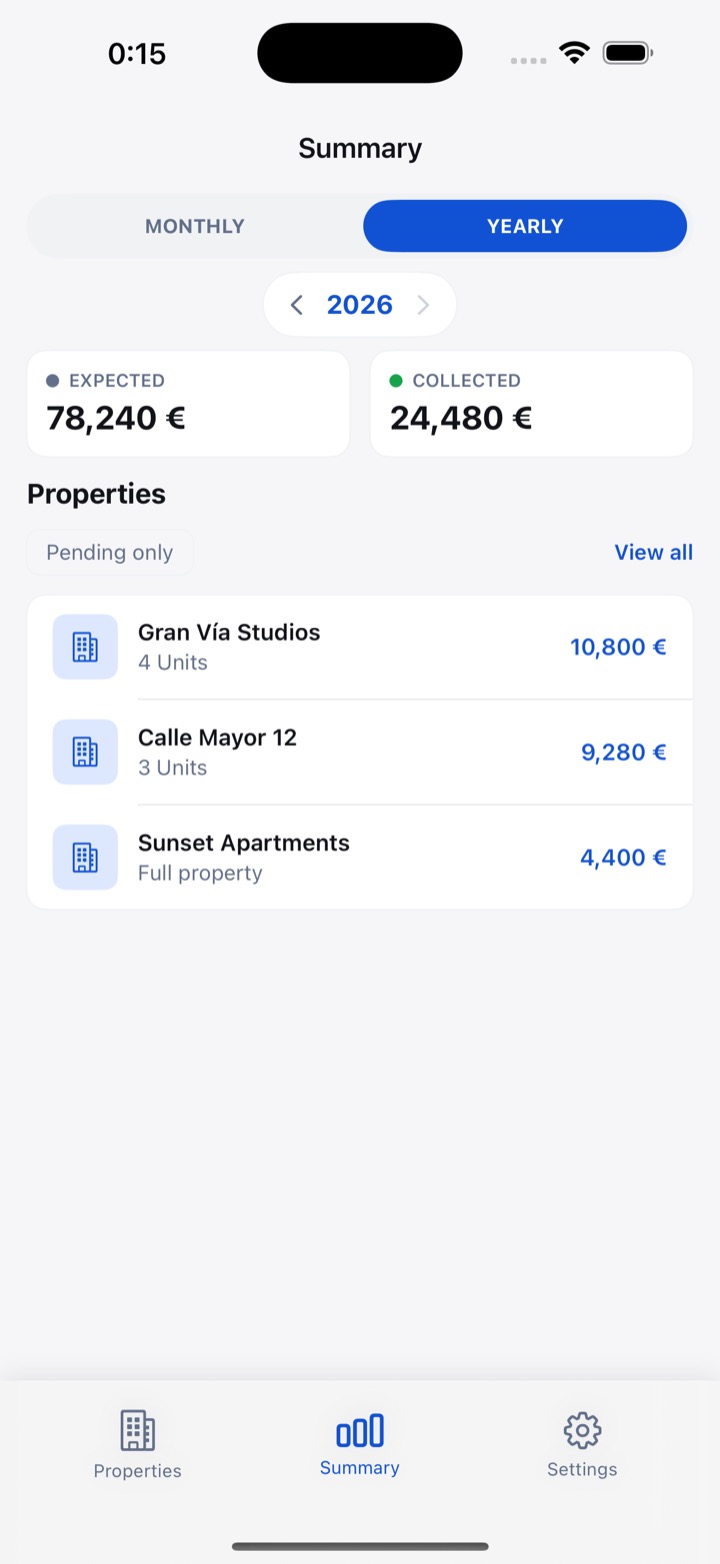
One practical note: RentDue tracks from the month you start. It does not fill in earlier months, so if a tenant already owes you from before, write that balance down separately before you set up the app.
Can a spreadsheet track missed rent payments?
A spreadsheet can track missed rent payments if you open it every month and fill in every row, which is exactly the habit that fails in a busy month. The file never warns you; a blank cell looks the same as a month you forgot to check. RentDue's advantage is the reminder and the overdue flag, not the data, which a sheet holds just as well.
If you'd rather keep the sheet, the trade-offs are laid out in how to track rent payments without a spreadsheet, and the free rent ledger template gives every unit a row each month before the rent arrives, so a missed month has somewhere to show up.
Is a missed rent tracker free?
RentDue is free, with ads, for up to 2 properties with 3 units each, with no account and no bank connection. Pro removes that limit and unlocks exporting the full year; on the free plan the export covers the last two months as a PDF. For a landlord with one or two rentals, the missed-rent part of the app costs nothing.
Paid tools do more, such as collecting rent through the platform or screening tenants. If what you need is to track missed rent payments and keep a clean record, a free app and a thirty-second check each month cover it.
Keep reading: Lease Due Date Tracking: Never Miss a Rent or Renewal Date · 5 Signs You Need a Rent Tracking App
Try RentDue
Every month starts as pending and turns overdue if the due day passes unpaid, so missed rent can't hide. Works offline, no account needed.
Free with ads: 2 properties of up to 3 units each, and exports of the last 2 months. Pro removes the limits and the ads, exports the full year and backs up to your own iCloud or Google Drive.