RentDue Stays · Guide
Short-Term Rental App for 1–3 Properties: Bookings and Real Profit
July 31, 2026 · 6 min read
Short-term renting has an admin problem that long-term renting never has: instead of one payment a month, you get ten bookings from three channels, each with its own rate, its own commission and its own cleaning slot. Airbnb shows you Airbnb. Booking.com shows you Booking.com. And the returning guest who booked direct is somewhere in your WhatsApp.
So a short-term rental app has exactly one job: pull all of it into one view — occupancy and money. Here is how to tell a good one from one you will abandon in week two.
What should a short-term rental app actually do?
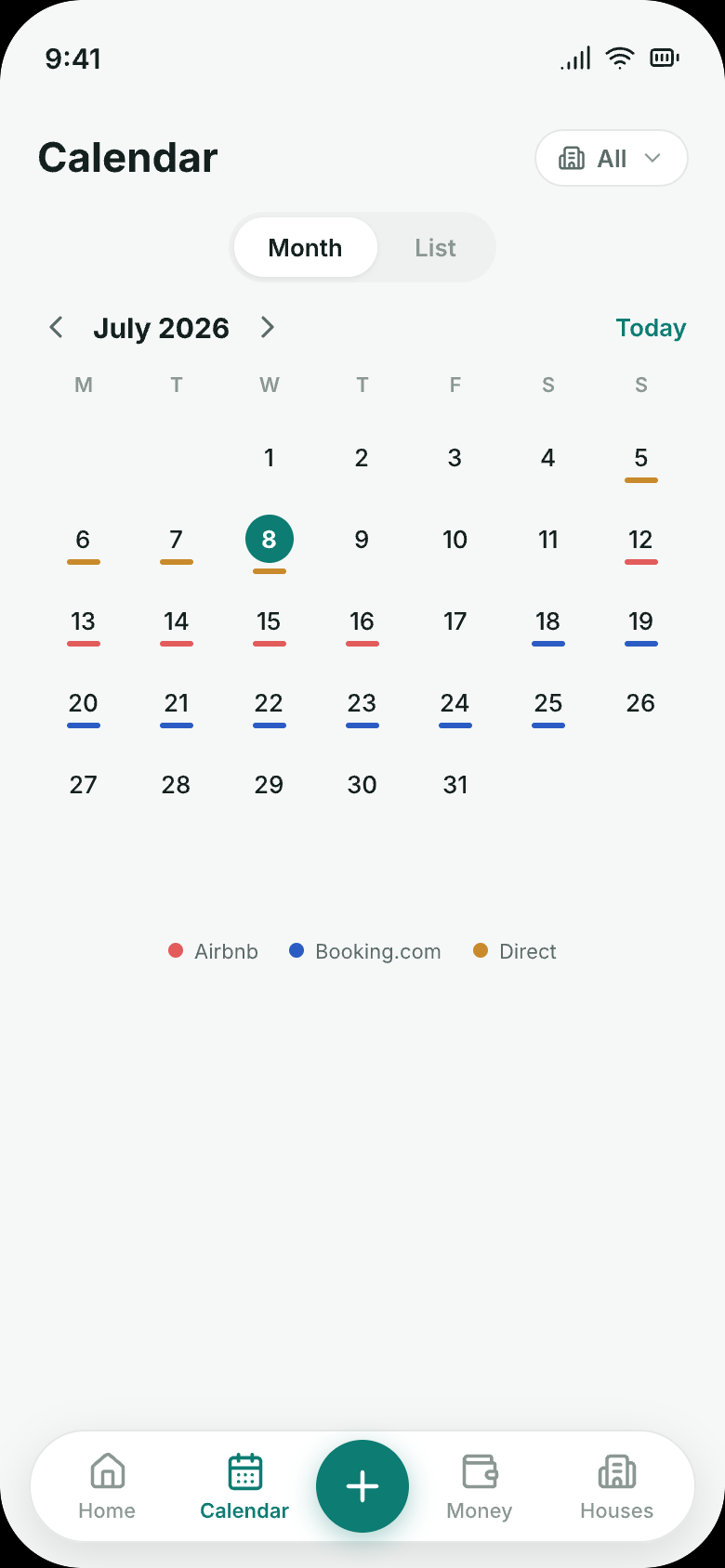
A short-term rental app has to bring three things into one view: every booking regardless of channel, occupancy per property, and the real profit left after fees and costs. That is exactly what we built RentDue Stays for — as the companion to RentDue for long-term rentals.
- Every booking in one place. Airbnb, Booking.com and direct bookings belong in the same list — otherwise you are running three calendars and hoping none of them collide.
- Occupancy at a glance. Which place is free this week, which one has a same-day turnover? That is a calendar question, not a spreadsheet question.
- Real profit, not gross revenue. Between the booking value and what you keep sit platform fees, cleaning and consumables. A good app does that math on every booking.
- Several places, judged separately. The beach flat and the city apartment run on different seasons — averaged into one number, both look “fine”.
Why isn’t the Airbnb calendar enough?
A channel calendar manages that channel and nothing else. The moment you list on two platforms or let repeat guests book direct, you open the exact gap where double bookings and forgotten deposits live. RentDue Stays closes it: you enter each booking in seconds, whatever its source, and get an instant overlap warning — instead of waiting on a sync that runs hours behind.
Direct bookings are the case that matters most: they are your most profitable stays (no platform cut) and your worst-documented ones — a message, a bank transfer, no system. In RentDue Stays they are a channel like any other, so your best channel stops being the invisible one.
Why RentDue Stays does not sync automatically
Almost every short-term rental tool leads with automatic sync to Airbnb and Booking.com. RentDue Stays deliberately does not, and the reason is the double booking itself: sync runs on a delay, and during that delay two platforms both still believe the same nights are free. Typing a booking in takes seconds, and the overlap warning is immediate rather than eventual.
The honest limit of that choice: if you run more than three places across several channels, entering bookings by hand becomes real work, and a full channel manager will serve you better than RentDue Stays. The app is built for private hosts with one to three places, not for agencies.
How do you see real profit, not just revenue?
The real profit on a booking is the booking value minus the platform fee, cleaning and variable costs. RentDue Stays does that math on every booking and shows you net profit per property and per channel. Gross revenue is the one number every platform puts front and center, and the one that tells you almost nothing when you have a decision to make.
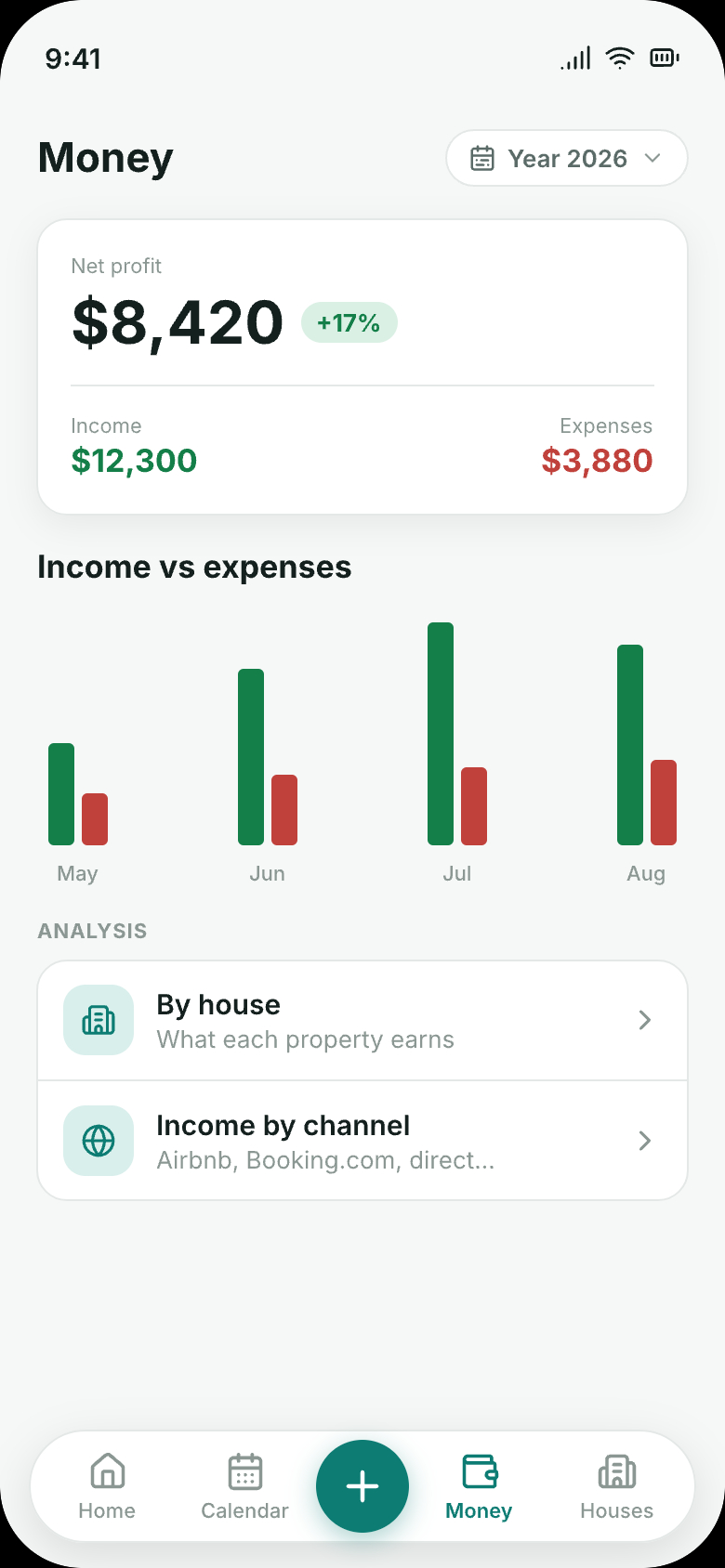
The same math on one example booking, so you can see how wide the gap really is:
| Line item | Example booking, 4 nights |
|---|---|
| Booking value | $480 — the number the platform celebrates |
| Platform fee | −$72 (roughly 3–18% depending on the channel) |
| Cleaning | −$60 |
| Consumables & small stuff | −$25 |
| Real profit | $323 — the number you should be planning with |
Only with that math do channels become comparable: a “worse paying” direct booking often beats an expensive platform booking by a clear margin. RentDue Stays breaks it down per channel, so by the end of the season you know which channel actually pays you.
Vacation rental, Airbnb, holiday let — is it all short-term renting?
Yes — for admin purposes it is one problem: short stays, changing guests, variable rates, several channels. The words differ, the booking list does not, and RentDue Stays treats all of them the same. The real differences sit elsewhere: tax, and the licensing and registration rules that apply where your place is. Those are set by your city or country, not by your app.
How much paperwork that means depends entirely on your address. Some cities want a licence number in the listing, some cap the nights you may rent per year, some ask for nothing at all — and across the EU, hosts of short-term lets have been covered by a mandatory registration scheme since 20 May 2026, the date Regulation (EU) 2024/1028 began to apply, which also obliges platforms to report booking data per unit every month. Check what applies to you before you list; that part is your local administration’s rulebook, not something an app decides. What the app gives you is the paper trail: RentDue Stays keeps a complete booking history and exports it as a PDF whenever your accountant or the tax office asks for it.
And if you rent long-term as well?
Then you want two tools with a clear division of labor: long-term renting lives on monthly status — did the rent arrive? — while short-term renting lives on bookings and profit per stay. RentDue covers the long-term side (for a small portfolio, start with the guide to rent tracking with 1 or 2 properties), and RentDue Stays covers holiday guests and short stays. Both work offline and without an account.
Keep reading: How to Track Missed Rent Payments (Before They Pile Up) · Why Your Rent Data Should Stay on Your Phone, Not the Cloud
Try RentDue Stays
Every booking — Airbnb, Booking.com, direct — in one view, plus the real profit on every stay. More on the RentDue Stays page.
download Download Free